Graduate’s passion project wins Scientific and Technical Oscar
Wednesday 15 July 2026
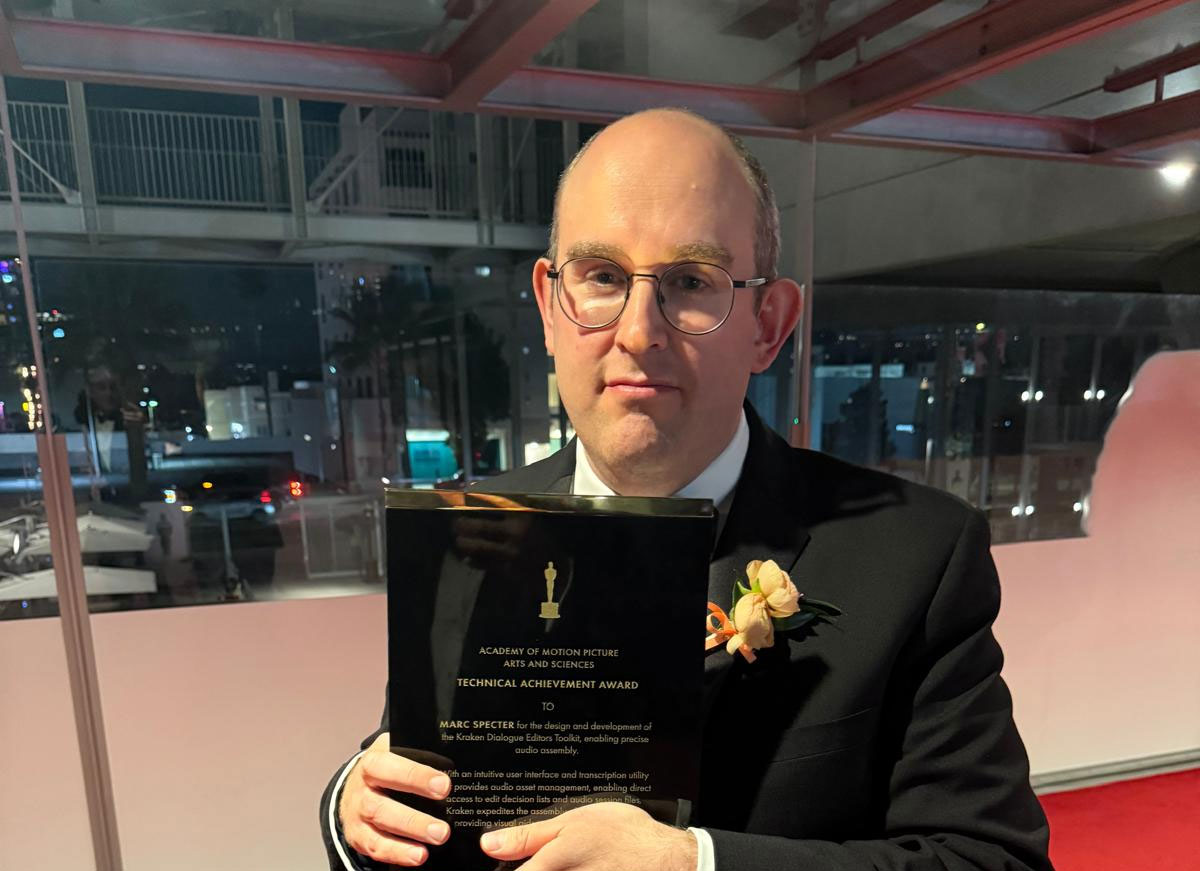
Music graduate Marc Specter has received an Academy of Motion Picture Arts and Sciences’ Scientific and Technical Award for a software tool he developed alongside his career as a dialogue editor.
Marc, who graduated from LIPA in 2002, was honoured with a Technical Achievement Award for creating the Kraken Dialogue Editors Toolkit, software that’s used on film and television productions around the world.
The Scientific and Technical Awards recognise innovations that have made lasting contributions to filmmaking. This year's recipients also included teams from leading studios including Framestore, DreamWorks Animation and Sony Pictures Imageworks.
We caught up with Marc to find out more about Kraken, winning an Oscar and his memories of LIPA.
Can you describe Kraken to us?
It’s a tool for post-production sound editing, specifically dialogue editing, that I made.
I've worked as a dialogue editor in film and television for more than 20 years and as a hobbyist programmer, and I used my knowledge of dialogue editing to gradually just put together different tools into one app. Eventually it became powerful enough to take to market. It's now used on film and television productions around the world.
And you developed Kraken independently, while still working as a sound editor. How challenging is that?
Well, that was one of the biggest problems. The main bulk of development would happen when I had no other jobs. Whenever I had gaps between freelance projects, I'd focus on coding. Over time, that grew into a second career alongside dialogue editing. When I'm busy with dialogue editing, I sometimes get frustrated that I can't spend time coding because it requires real focus. It's not something you can dip into for an hour here and there.
Has developing software been an interest of yours for a long time?
I’ve always had, what I call ‘the nerd brain’. I've been fascinated by what a computer can be made to do and how programming languages and scripts give you the power to make anything you can think of happen.
I've always had a deep fascination with the inner workings of computers, as well as audio, so bringing them together has been great fun.
How did it feel when you got that scientific and technical Oscar this year?
After I’d been shortlisted, I didn’t know how or when I’d be told if I’d won. In fact, someone I know who had won one a few years ago told me that you find out in January before it’s released to the public. I didn’t hear anything so assumed it wasn’t happening. Then in March I received a text from a friend congratulating me. I had no idea what it was about, so I checked the Academy's press release – and that's how I discovered I'd won.
It was quite emotional really. I did get a bit teary letting my family know because they’d been so keen to find out if I’d won.
What was the ceremony like?
Absolutely fantastic. I had to prepare a one-minute speech and then read it from an autocue. There was a wonderful dinner, and I was surrounded by incredibly talented scientists and technicians. Talking to them was one of the highlights of the evening.
What’s your favourite memory of your time at LIPA?
I studied Music and one of my favourite experiences was playing bass in the musical theatre orchestra. I loved seeing the actors, musicians, stagecraft and technology all come together. Looking back, it was probably the beginning of my interest in film and television. I've always loved that teamwork where everyone brings different skills together to create something special. I’m still humbled by that.
What’s next for you?
I'm working on a new version of Kraken that makes better use of AI, although that's proving a real challenge. I also have a second app called Orion. What I enjoy most is creating tools that genuinely help people do their jobs better and faster.